How to find low competition keywords in 2026
TL;DR: To find low competition keywords, mine Google Search Console impression data, use Semrush to analyze competitor keyword gaps, and target long-tail, entity-rich queries that bypass AI overview crowding to drive fast organic traffic.
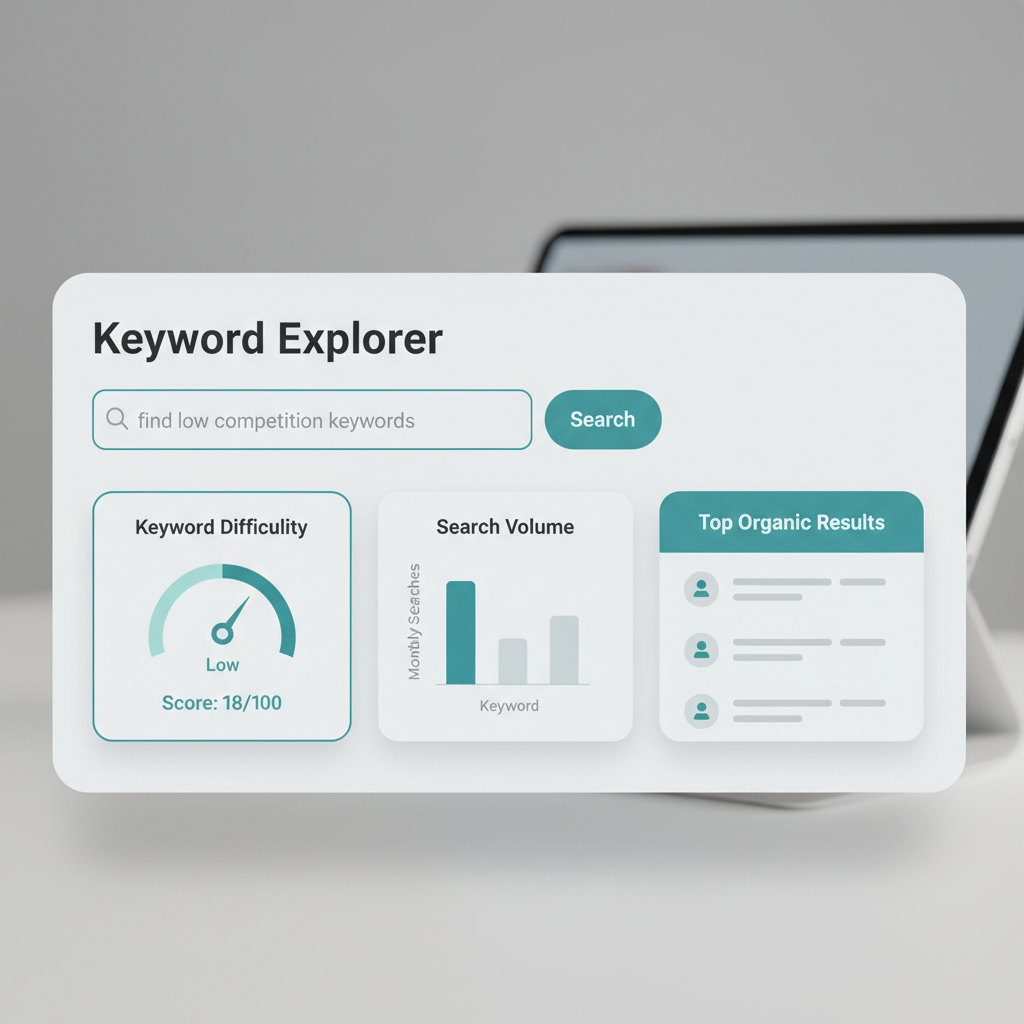
How to Find Low Competition Keywords in 2026: Step-by-Step Guide
By Seobase · Updated August 21, 2026 · 12 min read
TL;DR: To find low competition keywords, mine Google Search Console impression data, use Semrush to analyze competitor keyword gaps, and target long-tail, entity-rich queries that bypass AI overview crowding to drive fast organic traffic.
Tired of writing content that gets buried on page five while established industry giants claim all the clicks? Learning how to find low competition keywords lets you bypass those authority gaps. You win by targeting specific search intent that big brands ignore. You target queries where AI overviews or zero-click results have not crowded out organic listings.
Standard metrics in tools like Semrush often miss these search shifts. You need a tighter filtering process to find real wins. We will cover how to find low-hanging fruit keywords in 2026 using first-party data and competitor gaps to accelerate your traffic growth.
What are low-competition keywords and why they matter
Defining the difficulty threshold
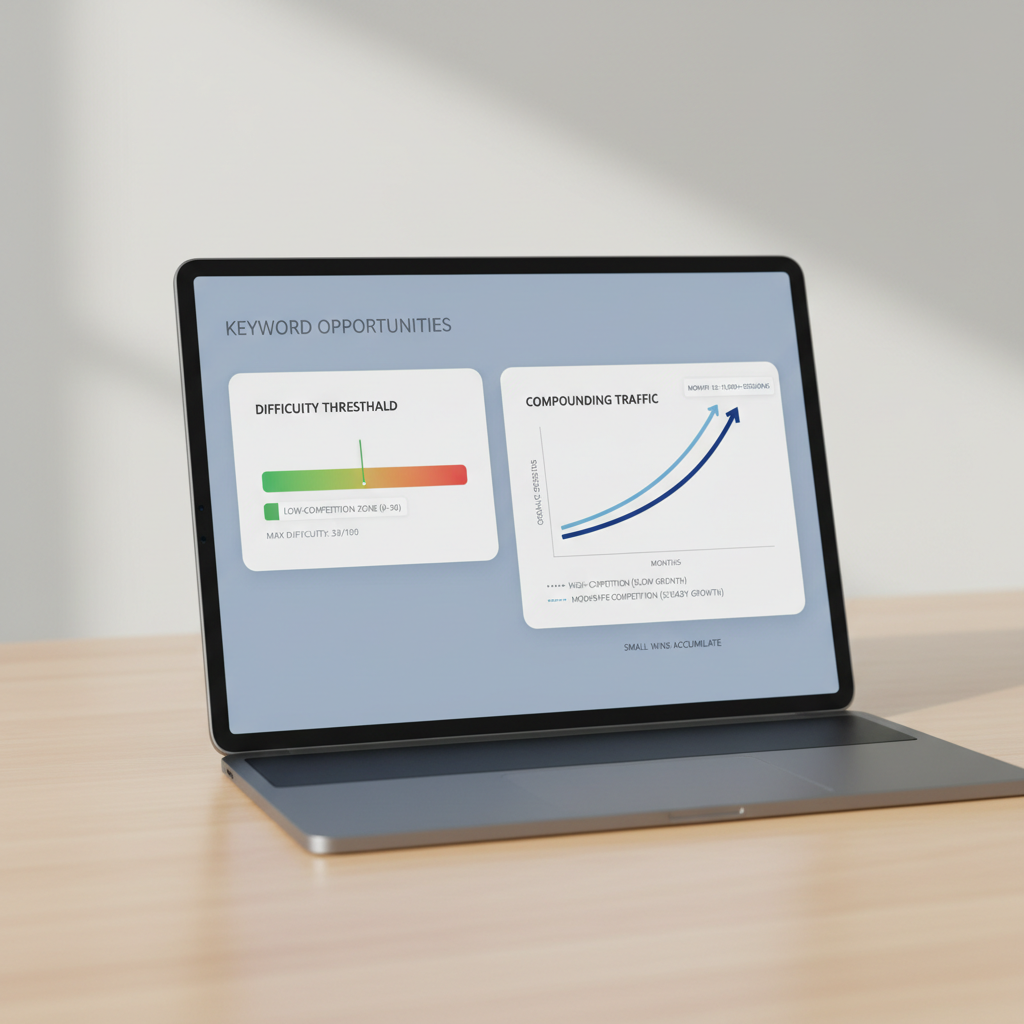
Low competition keywords are search terms that do not require massive domain authority to hit page one. Instead of fighting for broad terms where giants dominate, you target specific queries where the current top results are thin, outdated, or irrelevant.
Most SEO tools quantify this using Keyword Difficulty (KD), a score from 0 to 100. For a site with a Domain Rating between 40 and 60, targeting KD 0 to 10 keywords is the fastest path to visibility. These posts typically rank within 6 to 12 weeks.
However, third-party KD scores only measure backlink quantity. They fail to reflect intent or SERP layouts. A term like “myfitnesspal login” might show a low difficulty score, but the intent is purely navigational. Users only want the official login portal. Focus on informational or commercial gaps where your content can actually satisfy the reader.
The power of compounding traffic
Targeting easy wins builds topical authority across your domain. Google evaluates your content clusters to decide if your site demonstrates subject-matter expertise. When you consistently answer a cluster of related questions, search engines rank your site for competitive head terms later.
Securing these smaller wins creates a foundation of steady, predictable traffic. This protects your site from the volatility of chasing high-volume queries that take over 12 months to move.
| Keyword Type | KD Range | Typical Timeframe | Strategy |
|---|---|---|---|
| Low Competition | 0-10 | 6-12 weeks | Build foundational authority |
| Medium Competition | 11-40 | 3-6 months | Target after winning the subtopic |
| High Competition | 41-100 | 6-18 months | High reward, high resource investment |
This approach turns your content library into a compounding asset. Each low-difficulty post signals search engines that you publish reliable answers. You can explore more advanced strategies on the Seobase SEO Blog to refine this process. Once you own the periphery of a topic, the center becomes much easier to capture.
The Google Search Console gaps protocol
Filtering high impression low click queries
Before paying for third-party subscriptions, check your own first-party data. Google Search Console tracks the exact search terms displaying your URLs, even when you do not earn the click. This query data provides an accurate map of your existing organic footprint within Google’s 16-month data window.
Open the Performance report and set your date range to the last 3 months. Sort the query table by Impressions in descending order. Look for phrases where impressions exceed 500 but the Click-Through Rate (CTR) remains below 2%.
When a query generates 1,000 impressions with only 10 clicks, you have found an optimization gap. Google considers your domain relevant enough to serve in search results, but users pick competing snippets. This indicates either poor title targeting or weak search snippet alignment. Use these free SEO tools to cross-reference these gaps with current search trends.
Keep in mind that Search Console data exhibits a 48 to 72 hour reporting delay. It also aggregates anonymized queries, so it will not show search terms with very low impression counts.
Optimizing existing pages for quick gains
Do not write a new post when you spot these high-impression gaps. Update the existing URL that already triggers those search impressions. Optimizing an indexed URL captures rankings faster than publishing a new post from scratch.
Follow this workflow to close the gap:
- Analyze the query to confirm if searchers want a direct answer, steps, or a comparison.
- Insert the target phrase into your H2 subheadings and body copy where contextually relevant.
- Write 2 to 3 detailed paragraphs that directly answer the query.
- Rewrite the meta title and description to make the value proposition explicit.
Targeting queries sitting at positions 8 through 20 yields rapid results. A few hundred words of clear, specific text can push an established URL into the top 5 results without building additional backlinks.
Mining competitor keywords for hidden opportunities
Setting up a gap analysis
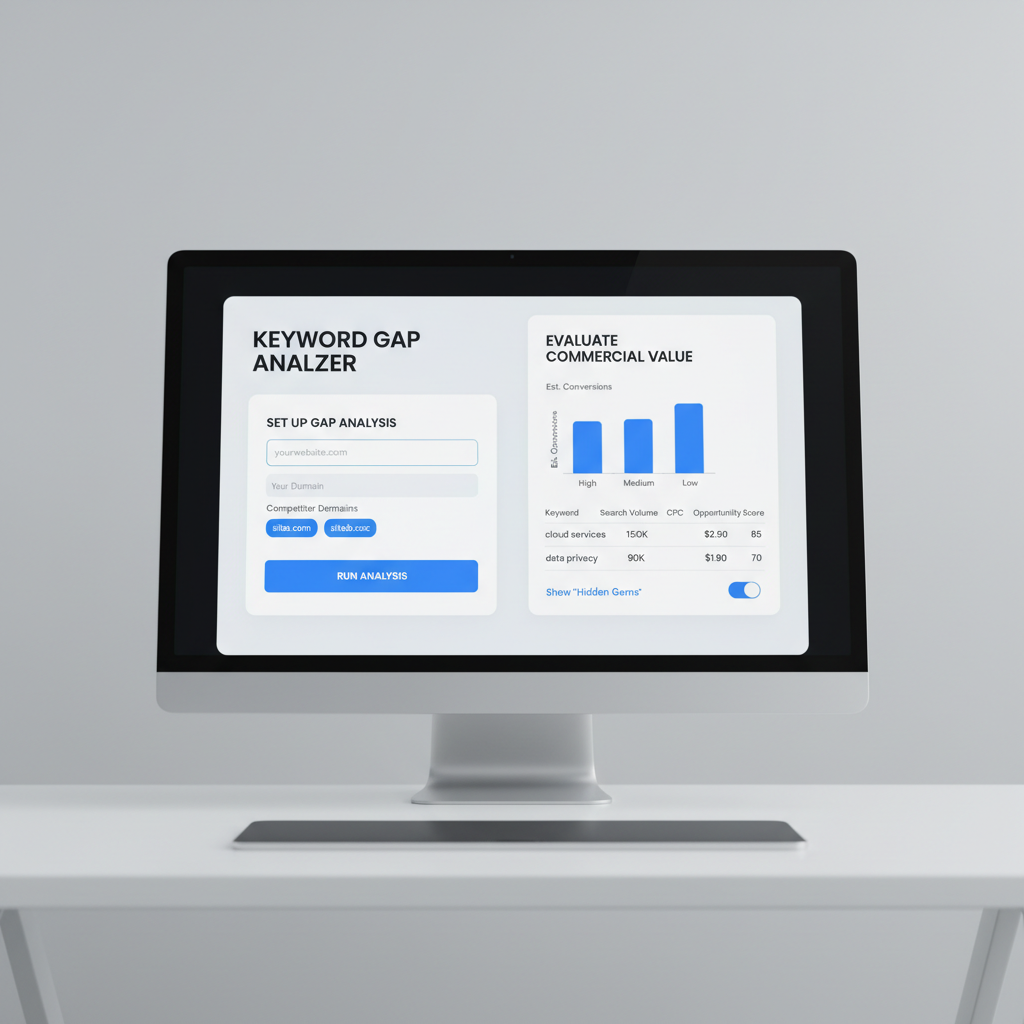
Competitive gap analysis uncovers search terms that competitors rank for while your domain lacks coverage. In tools like Semrush (starting at $139.95 per month) or Ahrefs (starting at $129 per month), enter your domain alongside up to 4 direct industry competitors. This comparison exposes overlapping keywords and identifies queries missing from your site.
Apply the “Missing” filter to isolate queries where multiple rivals rank in the top 20 positions while your site ranks outside the top 100. Filter the resulting list for keyword difficulty below 20. These gaps represent vulnerable topics where competitors often rank with thin or outdated content.
The limitation of gap tools is their reliance on static keyword databases. They often miss emerging long-tail queries for up to 60 days after search interest begins.
Evaluating commercial value
Search volume does not equal revenue. A search query can register 5,000 monthly searches, but pure informational queries often yield low conversion rates. To evaluate keyword profitability, inspect the Cost Per Click (CPC) data in Google Ads Keyword Planner.
A high CPC (such as $4.00 to $15.00 per click) proves that businesses spend advertising budget on that traffic. When a keyword shows low organic difficulty alongside a high CPC, you have found a valuable opportunity. The traffic converts well, yet the organic SERP remains uncompetitive.
Filter your candidate list with these criteria:
- Search volume: Target terms with 50 to 1,000 monthly searches to avoid broad competition.
- Difficulty: Filter for KD scores under 20 where forum threads or generic directories rank on page one.
- Intent: Match the term to commercial evaluation, such as comparisons, alternatives, and use-case queries.
Beating AI overviews with entity-rich long-tail queries
Understanding modern SERP changes
Standard keyword metrics evaluate backlink counts on competing URLs. They do not account for SERP feature crowding. AI overviews now occupy the top section of results pages, answering basic queries directly on Google.
A URL can hold position 1 while organic clicks decrease because an AI snapshot resolves the user’s intent immediately. This dynamic produces zero-click queries where Google logs search impressions, but analytics software tracks no sessions.
Avoid single-concept queries that require simple definitions. If a query asks “what is keyword difficulty,” automated summaries satisfy the user. Target multi-layered queries where searchers require nuanced, real-world examples.
Targeting entity-rich search phrases
To win organic clicks against automated summaries, increase semantic entity density in your content. Incorporate concrete concepts, tool names, constraints, and operational details that generic models skip.
Consider the broad query “best coffee maker.” Search algorithms summarize standard product lists easily. Change your target to a long-tail query like “burr grinder settings for light roast pour over brewing.” This query requires technical precision, specific grind sizes, and practical troubleshooting steps.
Ground your content with these elements:
- Name exact software versions, hardware specs, or pricing tiers ($49 vs $99).
- Explain concrete technical trade-offs between two workflows.
- Include practical troubleshooting steps derived from direct experience.
Detailed content captures clicks because users seeking advanced solutions bypass surface-level summaries.
Automating research and publishing with Seobase

Manual keyword research takes 4 to 6 hours per batch: exporting search queries, verifying volume, and cross-referencing difficulty scores across multiple browser tabs. Seobase streamlines this workflow by discovering low competition keywords, planning content clusters, and generating publish-ready drafts.
Finding keywords worth chasing
Rather than leaving you to guess which keywords will rank, Seobase analyzes your niche to highlight opportunities based on actual ranking difficulty. If you run a pet-care publication, typing “dog training” will not just return that oversaturated phrase.
The platform flags targeted alternatives like “leash reactivity training at home,” a low competition keyword with steady demand and weak competition. This allows your team to target underserved search queries that established publications neglect.
Turning keywords into a real content calendar
Organizing raw keyword exports into an actionable publishing schedule presents another bottleneck. Seobase generates an automated content calendar, grouping related search terms into structured topic clusters. This setup prevents keyword cannibalization across your domain.
The built-in writing engine drafts structured articles tailored to match search intent. You retain complete editorial control to refine voice, inject proprietary data, and adjust messaging. The initial drafting process drops from 4 hours to under 15 minutes per article.
Publishing without the copy-paste shuffle
Most SEO tools stop at reporting metrics. Seobase connects directly to CMS platforms like WordPress, Webflow, Shopify, Framer, Wix, and Ghost. It publishes formatted articles with headers, AI-generated images, and metadata without requiring manual copy-pasting.
Automating keyword discovery, content creation, and CMS publishing builds a consistent organic acquisition engine. Every low-competition query you target adds indexable assets that compound over time. Check out Seobase to inspect the full workflow.
Summary of low-competition keyword strategy
Combine first-party Search Console performance data with gap analysis exports from tools like Ahrefs or Semrush. Identify queries where your URLs rank on page two without dedicated content pages.
Prioritize long-tail, entity-dense search terms. Specific phrases help you bypass zero-click AI summaries and attract qualified visitors who have clear search intent.
How to prioritize your list
Filter your prospective keyword targets using this criteria:
- Intent alignment: Select terms that support lead generation, product sales, or direct subscriber growth.
- Semantic depth: Choose topics where you can cover related sub-entities, tools, and technical parameters.
- Difficulty thresholds: Keep target keyword difficulty below 20 on new or growing domains to secure rankings within 90 days.
Your next move
Build an initial batch of 10 to 20 articles targeting low-competition search phrases. Use clear content briefs to structure headings, semantic entities, and direct answers before writing.
Executing a focused keyword strategy allows your site to establish topical authority without relying on high-authority backlink profiles. Speed and consistency build long-term search visibility.
Frequently asked questions
What is considered a low competition keyword?
A low competition keyword is a search query with low ranking difficulty, typically with a KD score below 20. New and medium-authority websites can rank on page one for these queries without extensive backlink acquisition campaigns.
How do I find low competition keywords for free?
You can find low competition keywords for free by extracting high-impression queries from Google Search Console, reviewing Google autocomplete suggestions, and analyzing questions in the People Also Asked section.
Are low search volume keywords worth targeting?
Yes. Keywords with 50 to 250 monthly searches convert at high rates because they carry specific commercial or troubleshooting intent. Accumulating rankings for multiple low-volume keywords builds aggregate organic traffic and topical authority.
How do AI overviews impact low-competition keyword research?
AI overviews answer basic informational queries directly on search results pages. To maintain organic click-through rates, focus on complex, entity-dense queries that require hands-on experience, multi-step workflows, or comparative technical analysis.
What is keyword difficulty and how is it measured?
Keyword difficulty is a metric from 0 to 100 that estimates how hard it is to rank on page one for a query. SEO platforms calculate this score primarily by analyzing the number and quality of unique referring domains linking to top-ranking pages.
How do I use Google Search Console to find keyword opportunities?
Open the Performance report, set the timeframe to 3 months, and sort queries by Impressions. Identify search terms ranking between positions 8 and 20 that have low click-through rates, then add dedicated sections answering those queries to your existing pages.
What is the difference between standard KD and personal keyword difficulty?
Standard KD measures global ranking difficulty based on the backlink strength of top-ranking pages across the entire web. Personal keyword difficulty adjusts that metric against your domain’s specific backlink profile, topical authority, and historical search performance.
Put this on autopilot
Seobase runs the whole loop for you: it finds the keywords worth ranking for, writes and publishes the articles, and reports back from Search Console on what actually moved.
Start a free Seobase workflowIn this guide
- How to Find Low Competition Keywords in 2026: Step-by-Step Guide
- What are low-competition keywords and why they matter
- The Google Search Console gaps protocol
- Mining competitor keywords for hidden opportunities
- Beating AI overviews with entity-rich long-tail queries
- Automating research and publishing with Seobase
- Summary of low-competition keyword strategy
- Frequently asked questions