AI-powered SEO agents: automate your search growth in 2026
You probably spend your workweek jumping between keyword tools, spreadsheets, and CMS dashboards just to update a few URLs. Most of this workflow is fragmented and slow. Ai-powered seo agents fix this problem by functioning as autonomous programs that plan, optimize, and execute search campaigns with minimal manual input.
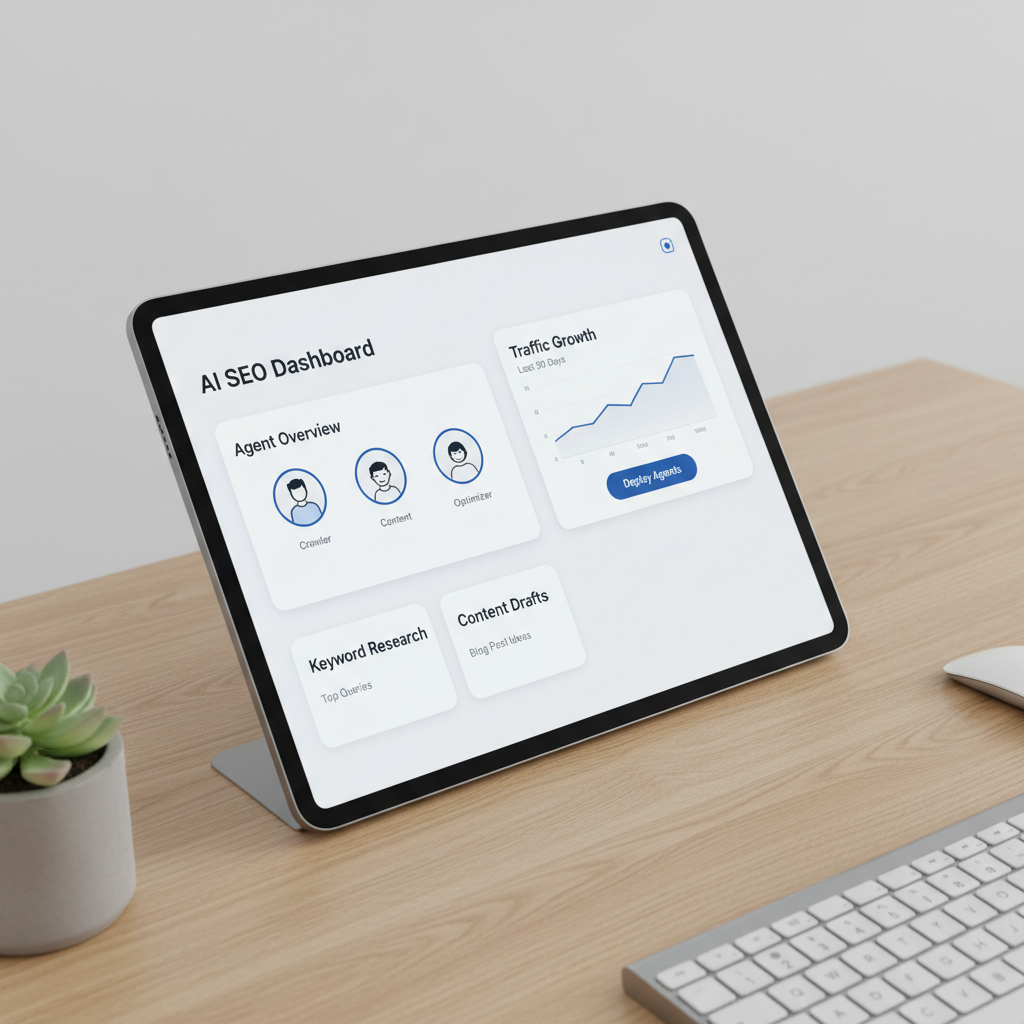
An AI SEO agent is a specialized software system that does not just generate recommendations. It carries out the work. These autonomous agents handle keyword discovery, group terms into intent-driven topical clusters, audit site health, and publish technical fixes in real time.
This guide shows you how to move away from static spreadsheets to AI SEO automation that scales your organic reach without inflating your payroll.
Traditional search optimization relies on slow manual steps. You export a CSV containing 1,000 keywords from a tool, spend six hours tagging intent in Google Sheets, and look for content gaps. That linear process breaks down when managing large websites. If your site has 5,000 indexed pages, your team cannot audit every page each month by hand.
Autonomous workflows eliminate this bottleneck. Instead of running individual searches, you assign an ai-powered seo agent an objective, such as winning market share in a software category. The agent queries search engines, inspects competitor pages, builds a topical cluster map, and drafts structured briefs. It can also update meta titles directly inside your CMS.
Real-time execution delivers immediate value. If a competitor publishes a 4,000-word comparison hub, an autonomous agent spots the shift within hours. It analyzes the new keyword footprint and flags the exact subheadings your live pages lack. You stop relying on lagging quarterly reports and start adapting instantly.
This shift is critical as AI-generated search results expand. Ranking requires managing vast datasets across technical health, semantic relationships, and content updates. Deploying ai-powered seo agents gives your team the automation needed to scale without adding headcount.
The operational differences look like this:
| Task | Manual Workflow | Agent Workflow |
|---|---|---|
| Keyword Research | Exporting CSVs and manual tagging | Continuous, real-time discovery via APIs |
| Clustering | Pivot tables and manual grouping | Algorithmic grouping by vector embeddings |
| Technical Fixes | Quarterly audits and manual Jira tickets | Automated pull requests and instant code patches |
Stop treating search optimization like a collection of manual data chores. When you deploy ai-powered seo agents, you build an automated pipeline that finds gaps and fixes them continuously.
TL;DR: AI-powered SEO agents are autonomous systems that execute keyword research, clustering, technical audits, and content publishing in real time. By combining vector maps and execution loops, they scale organic growth while reducing manual overhead.
On this page
- Under the hood of modern SEO agents
- Core tasks automated by AI-powered search agents
- Cost-to-ROI operational analysis for automation
- Scaling content publishing with Seobase automation
- Failure modes and safety guardrails to enforce
- Embracing autonomous search workflows for growth
- Frequently asked questions
- What tasks can an AI-powered SEO agent actually automate?
- Do AI SEO agents require coding skills to set up?
- How do AI SEO agents connect to live search and site data?
- Should SEO agents operate fully autonomously?
- How do AI SEO agents handle technical SEO audits and code fixes?
- What data sources do AI SEO agents plug into for live search metrics?
Under the hood of modern SEO agents
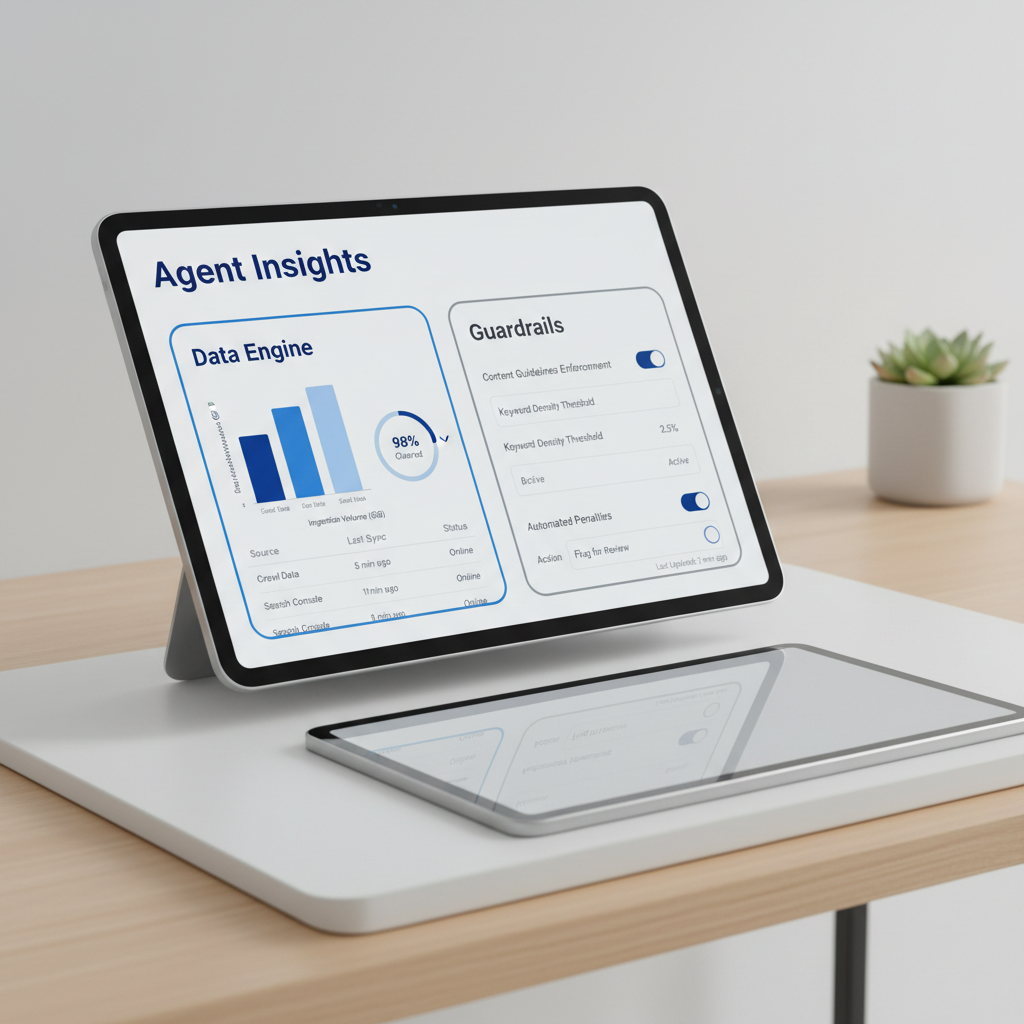
Modern ai-powered seo agents replace static checklists with continuous execution loops. An agent monitors your URLs, spots an indexing drop or 404 response code, and initiates an immediate fix.
graph TD
    A[Execution Loop] --> B[RAG Knowledge Base]
    B --> C[Vector Embedding Map]
    C --> D[Action: Update Content]
    D --> E[Rate-Limit Throttler]
    E --> A
The data engine
To avoid hallucinations, an ai-powered seo agent uses retrieval-augmented generation (RAG) knowledge bases. Instead of guessing from pre-trained weights, the agent extracts real metrics from Google Search Console, server access logs, and live crawl data.
The system structures this data using vector embeddings. Embeddings represent keywords and search intents as mathematical coordinates. For instance, when evaluating “B2B SaaS churn,” the system automatically groups semantic concepts like “customer retention strategies” and “LTV calculation.”
However, vector clustering has clear limitations. LLMs often fail to interpret nuanced intent shifts when a query demands personal experiences or product demonstrations. An agent cannot replace human testing for subjective product reviews.
The guardrails
Unchecked autonomous agents can overload search APIs or trigger account blocks. For example, hitting standard Ahrefs or Google Search Console API tiers too quickly leads to 429 rate-limit errors. Developers add API throttling modules that restrict requests to specific rate tiers (like 60 calls per minute).
The core stack contains three primary layers:
- Orchestration: LangChain, AutoGPT, or custom Model Context Protocol (MCP) clients direct logic flows.
- Memory: Pinecone, Weaviate, or Qdrant stores page-level vector embeddings.
- Connectivity: Python workers connect directly to CMS REST APIs and GitHub repositories.
This configuration lets an agent monitor 10,000 URLs continuously. It identifies missing meta tags, calculates structural debt, and flags underperforming pages for review.
Core tasks automated by AI-powered search agents
Four repetitive tasks consume the bulk of an organic search team’s weekly bandwidth. Autonomous agents handle these workflows end-to-end.
Mining keywords at scale
AI keyword research agents process high-volume query datasets. An agent extracts search volume, CPC, ranking volatility, and competitor SERP features for 25,000 queries across multiple markets in minutes.
The real strength is continuous tracking. If user queries spike around a breaking industry event, the agent surfaces that trend immediately. You avoid waiting for third-party databases to update their monthly static indexes.
Building topical silos with vector clustering
Sorting thousands of keywords by intent is where manual SEO workflows stall. An ai-powered seo agent computes cosine similarity across keyword vectors. It creates clear topical clusters instead of forcing staff to sort pivot tables.
The result is a clean topical silo: one foundational pillar page linked to supporting sub-topic articles. This structure prevents internal keyword competition before writing begins.
Fixing technical issues automatically
Technical SEO automation monitors site infrastructure. An agent tracks Core Web Vitals metrics, identifies Largest Contentful Paint (LCP) regressions above the 2.5-second threshold, and inspects broken canonical tags across dynamic product templates.
The agent generates structured data (such as Product, Article, or FAQPage JSON-LD schemas) and tests it against schema validators automatically. It then creates a pull request on GitHub so developers can review the fix with one click.
Optimizing internal linking graphs
Internal linking distributes PageRank and contextual relevance across your site. An ai-powered seo agent scans your full sitemap as a directed graph, detects orphan pages with zero inbound links, and inserts contextual anchor text into relevant older posts.
Combine automated graph updates with Google Search Console monitoring to confirm that indexing rates and impressions rise after internal link additions.
Cost-to-ROI operational analysis for automation

Traditional agency retainers typically cost between $3,000 and $10,000 per month. These retainers charge a fixed price regardless of the specific number of pages an agency optimizes. Agent workflows replace fixed overhead with direct compute usage.
Token spend vs. human labor
Human production scales linearly: doubling content volume requires doubling freelance budgets or internal staff. Token pricing models break this constraint.
Using models like GPT-4o-mini (costing roughly $0.15 per 1 million input tokens and $0.60 per 1 million output tokens), an ai-powered seo agent can analyze, cluster, and brief 1,000 keywords for less than $3.00 in compute. A junior SEO analyst would take 20 hours to perform the same task.
Manual Agency Cost: $5,000/mo (Fixed, 10-15 deliverables)
Agent Pipeline Cost: $150-$400/mo (Compute tokens + API subscriptions, unlimited runs)
However, token costs can escalate rapidly if your agent runs unoptimized recursive loops. Agents that evaluate 50-page crawl graphs without token caching can burn through API budgets in hours.
Budget protection and fallback mechanisms
To safeguard your API budget, deploy deterministic fallback rules:
- Max Token Limits: Hard-cap each research run at 50,000 tokens.
- Loop Exits: Kill any extraction script that fails to return valid JSON after three retries.
- Cost Caps: Set strict monthly billing thresholds inside your AI platform dashboard.
| Expense Type | Scaling Factor | Cost Predictability | Primary Limitation |
|---|---|---|---|
| Agency Retainer | Fixed Monthly ($3k-$10k) | High | Slow turnaround times |
| Freelancer | Per Word ($0.10-$0.40/word) | Medium | Variable output quality |
| Token Consumption | Per Request ($0.15-$2.50/M tokens) | Variable | Requires technical setup |
Scaling content publishing with Seobase automation
Clustering keywords and generating briefs by hand takes hours before writing even begins. Seobase consolidates research, intent grouping, drafting, and scheduling into a single automated workflow.
From keyword to calendar without spreadsheets
The automated keyword research engine in Seobase does not just deliver flat volume numbers. The tool organizes related queries into unified clusters automatically.
It maps these clusters directly into an automated content calendar based on search demand and keyword difficulty. For fast outlining, the content brief generator creates complete heading structures, semantic entity lists, and target questions in a single step.
Eliminating the writer bottleneck
Writing teams often struggle with production backlogs. Seobase uses integrated AI article generation to draft comprehensive articles directly from structured briefs.
Once generated, the system connects directly to WordPress, Webflow, Shopify, Framer, Wix, and Ghost. It formats headings, embeds metadata, and adds featured visuals without requiring manual CMS uploads.
Maintaining editorial quality controls
Speed without editorial standards results in repetitive content. Seobase provides an article review workflow so editors can review and refine drafts before they go live — every generated draft goes through a content-quality gate before publishing, not just a spell-check.
Failure modes and safety guardrails to enforce

Fully unconstrained autonomous systems can break live sites. An ai-powered seo agent might suggest redirects to non-existent URLs or produce invalid schema code. These errors trigger 404 response spikes and Search Console validation errors.
Always test automated code in a staging environment. Run local audits with tools like Screaming Frog (which offers free testing up to 500 URLs) before deploying automated changes to production.
Preventing keyword cannibalization
Autonomous publishing can accidentally generate overlapping pages that target identical search queries. When an agent creates 40 articles without checking existing URLs, it causes keyword cannibalization. Search engines struggle to identify the canonical URL, which lowers overall rankings.
To prevent this issue, connect your agent to a live index database. Require the agent to run a similarity check against your sitemap before drafting new material. If a live URL shares high semantic similarity with a new keyword, the system should update the existing page instead of creating a duplicate.
Human-in-the-loop approvals
Autonomous agents must not push critical structural updates without human review. High-risk operations require manual confirmation:
- Redirect Maps: An SEO specialist must verify 301 destinations to avoid redirect loops.
- Robots.txt Edits: A single syntax error can de-index an entire domain within 48 hours.
- Sitewide Title Updates: Edits to your top-revenue templates require approval from the marketing lead.
Set up pull requests on GitHub or GitLab for code-level changes. The ai-powered seo agent opens the branch, tests the syntax, and waits for human approval before merging.
Embracing autonomous search workflows for growth
Search optimization is evolving into a systems-management discipline. Using ai-powered seo agents allows your team to automate routine data collection, technical checks, and drafting while reserving human judgment for brand positioning and strategic direction.
Setting boundaries on autonomous actions
A hybrid model provides both speed and security. An ai-powered seo agent can process 5,000 search queries overnight, build vector clusters, and generate content briefs.
Your editorial team then decides which briefs align with commercial priorities. Human oversight prevents brand drift while the agent eliminates hours of manual data preparation.
Where to start your implementation
Do not automate your entire SEO strategy at once. Start with a single narrow pipeline, such as automated internal link insertion or 404 redirect detection. Run the process in staging for three weeks, inspect the logs, and refine the prompts.
Once the initial pipeline runs reliably, expand into automated brief generation and draft scheduling. To stay updated on autonomous publishing frameworks, follow the Seobase SEO blog for technical guides and operational workflows.
Frequently asked questions
What tasks can an AI-powered SEO agent actually automate?
An ai-powered seo agent automates keyword extraction, semantic intent clustering, internal link graph updates, meta tag generation, Core Web Vitals monitoring, structured data creation, and CMS publishing across platforms like WordPress and Webflow.
Do AI SEO agents require coding skills to set up?
Not necessarily. Platforms like Seobase provide no-code interfaces for automated research, writing, and CMS publishing. However, custom Python setups using LangChain, AutoGPT, or Model Context Protocol (MCP) require developer knowledge.
How do AI SEO agents connect to live search and site data?
Agents connect via REST APIs to Google Search Console, Google Analytics 4, third-party SEO databases, and direct CMS webhooks. They can also connect to GitHub repositories to submit code-level site changes via pull requests.
Should SEO agents operate fully autonomously?
No. Fully unconstrained agents can introduce keyword cannibalization, invalid redirects, or off-brand copy. Use a human-in-the-loop approval step for CMS publishing, robots.txt edits, and sitewide template updates.
How do AI SEO agents handle technical SEO audits and code fixes?
Agents crawl URLs, detect technical errors such as missing canonical tags or slow LCP elements, generate the required HTML or JSON-LD fixes, and push code changes directly to staging environments for review.
What data sources do AI SEO agents plug into for live search metrics?
Agents typically integrate with Google Search Console for impression and click data, third-party data providers for keyword volumes, and vector databases (such as Pinecone or Weaviate) containing indexed site embeddings.
Put this on autopilot
Seobase runs the whole loop for you: it finds the keywords worth ranking for, writes and publishes the articles, and reports back from Search Console on what actually moved.
Start a free Seobase workflowIn this guide
- Under the hood of modern SEO agents
- Core tasks automated by AI-powered search agents
- Cost-to-ROI operational analysis for automation
- Scaling content publishing with Seobase automation
- Failure modes and safety guardrails to enforce
- Embracing autonomous search workflows for growth
- Frequently asked questions