SEO Content Brief Generator: Build Better Article Plans (2026)
An SEO content brief generator turns a target query into an editorial plan before anyone spends time drafting. The useful output is not a list of keywords: it is a clear reader, intent, angle, outline, proof requirements, questions, internal links, and a definition of done.
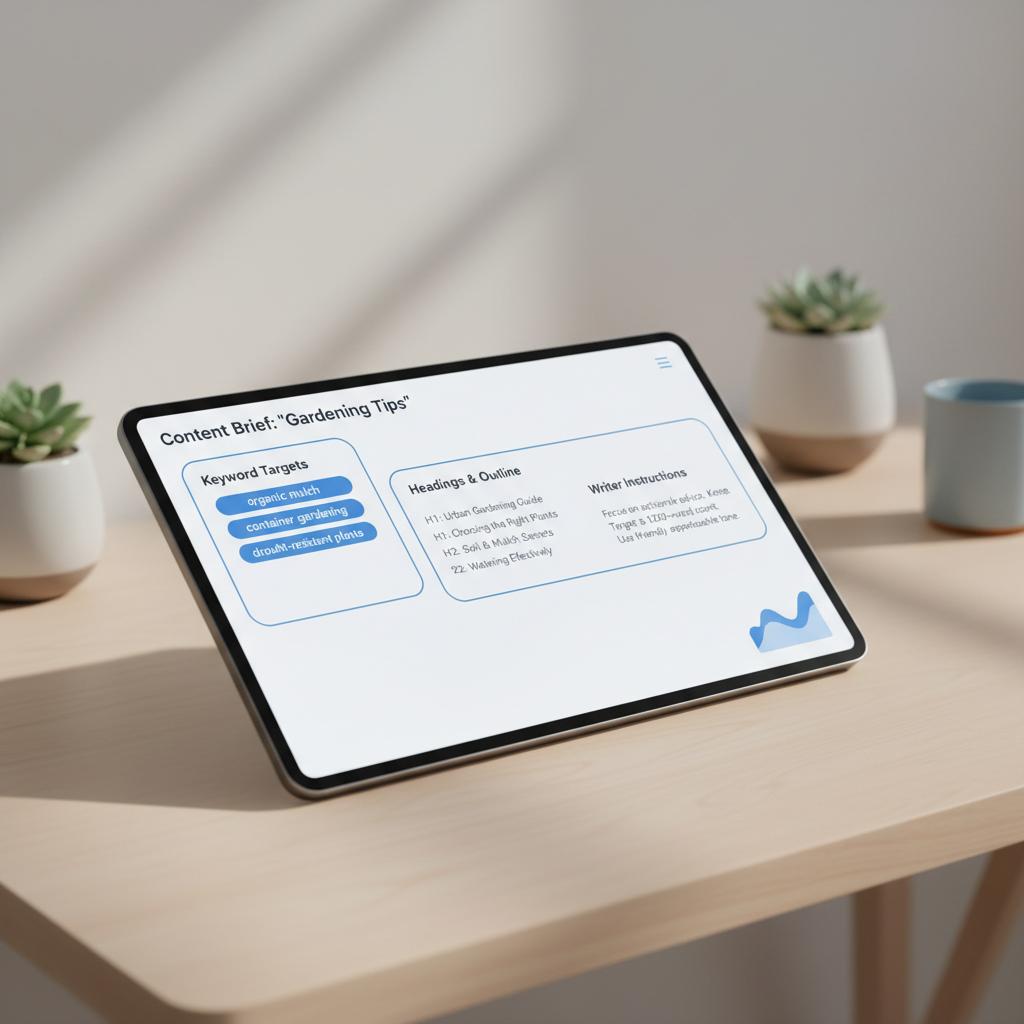
Short answer: use the free SEO content brief generator for one query at a time, then compare its starting outline with the current search results and add evidence only your team can verify. When the brief is approved, hand it to a writer or move it into the AI SEO content generator for a structured first draft.
Last reviewed: September 10, 2026.
What is an SEO content brief generator?
An SEO content brief generator creates the decisions that should come before an article: which searcher the page serves, what answer belongs near the top, which subtopics are necessary, what evidence is required, and where the reader should go next. It should make a page more useful and easier to review, not encourage publishing a larger number of interchangeable URLs.
| Brief component | Question it answers | What to verify |
|---|---|---|
| Target query | What did the searcher actually ask? | Country, language, device, and the wording of the live result set. |
| Search intent | What job is the visitor trying to complete? | Whether results are tools, workflows, comparisons, or product pages. |
| Audience and angle | Why should this page exist? | A specific reader and a useful point of view, not a generic summary. |
| Proof plan | Why should anyone trust the answer? | First-hand examples, exports, screenshots, dates, and primary sources. |
| Internal links | What is the next helpful action? | Working, topical destinations that match the section promise. |
How to use an SEO content brief generator
1. Start with one query and one canonical page
Enter the query you can genuinely serve and decide whether an existing URL already owns that intent. Do not create a second article merely because a variation uses different word order. Consolidating close variants keeps the evidence, links, and future updates on one page.
2. Choose the intent before writing the outline
A “how to” query needs a reproducible workflow. A comparison needs dated evidence and a decision table. A tool query needs a working interaction and a direct explanation of the output. If the brief cannot state the job in one sentence, the query is not ready for production.
3. Add the answer and the limitation near the top
The opening should resolve the main question quickly, then explain what the page does not promise. For example, a brief generator can organize a research plan; it cannot prove that every keyword has known difficulty, guarantee a ranking, or replace a review of the current results.
4. Turn the outline into a proof checklist
For each major section, name the evidence a writer must add: a real export, a before-and-after example, a screenshot, a primary source, or a clearly labeled product observation. This is where a generic AI draft becomes an article with a reason to exist.
5. Define the next action and the measurement window
Link the reader to the tool, template, or product workflow that solves the next problem. After publishing, record the canonical URL, target query, impressions, clicks, position, and conversions in a complete comparison window. A content score is not a result.
What a good brief should produce
A useful brief should leave a writer with fewer judgment calls, not more. It should include:
- the primary query and closely related questions that belong on the same page;
- the intended reader, business fit, and search intent;
- a direct-answer opening and a practical H2/H3 structure;
- entities, examples, FAQs, and proof requirements;
- internal-link targets such as a relevant free tool or workflow guide;
- claims that need a source or a label as a product observation;
- the review gate, publication destination, and post-publication measurement plan.
Seobase’s content brief generator creates this starting structure in the browser. Review it against the current SERP, remove sections that do not help the reader, and add first-hand information before drafting.
Worked example: “SEO content brief generator”
For this query, the page should not be another generic definition. The reader is looking for a usable tool, so the brief should put the interaction and its output near the top, explain what inputs matter, show a short workflow, and link to the next production step.
| Brief decision | Example |
|---|---|
| Primary job | Create a reviewable plan for one SEO article before drafting. |
| Opening answer | Use the generator to frame intent, audience, outline, proof, questions, and internal links. |
| Proof | Show the generated structure, then explain which parts still require human research. |
| Next action | Move an approved brief into a structured AI article draft and review every claim. |
| Limit | The brief is not a live SERP guarantee and does not make a weak query commercially relevant. |
Brief generator vs. article generator vs. full automation
These are different workflow stages. A brief decides what deserves to be written. An article generator produces a structured draft. Full SEO content automation connects research, briefs, drafting, review, publishing, and measurement.
| Stage | Use it when | Human responsibility |
|---|---|---|
| Content brief | The angle and outline are still uncertain. | Choose the canonical intent and evidence. |
| AI article draft | The plan is approved and a writer needs a first pass. | Rewrite the opening, verify claims, and add real examples. |
| SEO automation platform | A team needs repeatable research-to-publish operations. | Set quality gates, approve destinations, and measure outcomes. |
That distinction is why Seobase connects the keyword clustering tool, content brief generator, and AI article generator without pretending that automation removes editorial judgment. See the broader AI SEO content automation workflow for the research, review, publishing, and measurement loop.
Common content brief mistakes
- Writing for a keyword instead of a person: name the job and the reader before adding related terms.
- Copying the current results: use them to understand intent, then add evidence or experience the competing pages do not have.
- Promising a ranking: difficulty estimates and content scores are prioritization signals, not outcomes.
- Publishing the draft unchanged: generic copy needs a human pass for accuracy, examples, links, and omissions.
- Creating near-duplicate URLs: keep close variants on the canonical page unless the audience and task are materially different.
Frequently asked questions
What should an SEO content brief include?
It should include the target query, reader, intent, angle, answer-first opening, outline, questions, entities, proof requirements, internal links, review criteria, and measurement plan.
Can an AI content brief guarantee rankings?
No. A brief improves planning and review. It cannot control Google recrawling, competition, links, search demand, or whether the finished page is more useful than the alternatives.
Should I use a brief generator before an AI article generator?
Usually. Approve the query, intent, structure, evidence, and destination first; then use an article generator for a draft that follows those decisions.
Is the Seobase content brief generator free?
Yes. The browser-based tool creates a starter brief without signup. You still need to review the live results and add evidence before publishing.
Sources and editorial method
This workflow follows Google’s people-first guidance: create original, useful information for readers and make the purpose of the page clear. For measurement, use the Google helpful content guidance and the Search Console performance report as primary references. Seobase product behavior described here is a product observation, not a ranking guarantee.
Generate a free SEO content brief before you draft your next article.
Put this on autopilot
Seobase runs the whole loop for you: it finds the keywords worth ranking for, writes and publishes the articles, and reports back from Search Console on what actually moved.
Start a free Seobase workflow