What is DR in SEO? Domain Rating explained for 2026
TL;DR: Domain Rating (DR) is a proprietary Ahrefs metric measuring backlink profile strength on a 0-100 scale. While helpful for competitor analysis and link prospecting, it is relative, not a Google ranking factor, and should be evaluated alongside organic traffic and content relevance.

By Seobase · Updated September 9, 2026 · 10 min read
TL;DR: Domain Rating (DR) is a proprietary Ahrefs metric measuring backlink profile strength on a 0-100 scale. While helpful for competitor analysis and link prospecting, it is relative, not a Google ranking factor, and should be evaluated alongside organic traffic and content relevance.
TL;DR: DR in SEO stands for Domain Rating, an Ahrefs metric on a 0 to 100 logarithmic scale that calculates backlink profile strength based on unique referring domains. It is not a direct Google ranking factor, but a relative tool to benchmark authority against competitors.

Understanding DR in SEO and Authority metrics

What DR actually measures
Understanding DR in SEO helps teams evaluate backlink strength without confusing third-party metrics with actual Google ranking factors. Domain Rating (DR) is Ahrefs’ proprietary score that tracks a website’s backlink profile on a 0 to 100 logarithmic scale. It compares your profile with every other domain in Ahrefs’ index. DR reflects backlink strength rather than search traffic or keyword rankings. Use DR in SEO audits to monitor link-building progress, not to predict rankings directly.
Why third-party scores cause confusion
A high DR score can mask weak relevance, low search traffic, or poor-quality referring domains. Because competing platforms use distinct algorithms, Moz Domain Authority and Semrush Authority Score will rarely match Ahrefs DR. This guide outlines how Ahrefs calculates DR in SEO, why your rating fluctuates, and how to evaluate backlinks accurately. Start with a free SEO checker to review the pages supporting your link strategy.
How Ahrefs calculates Domain Rating on a logarithmic scale
The logarithmic scale math
According to Ahrefs documentation, Domain Rating estimates backlink profile strength on a 0 to 100 logarithmic scale. It maps link equity from referring domains against every domain in the Ahrefs index. Ahrefs explicitly designs DR as a relative comparison tool, not a ranking algorithm.
Because the scale is logarithmic, advancing from DR 20 to 21 requires far fewer referring domains than jumping from DR 75 to 76. At the higher end of the spectrum, sites compete directly against massive, established web properties with thousands of referring domains.
The lower end of the scale moves quickly when a new site secures clean links. Higher tiers demand significantly higher link volume and domain authority to move a single point. Ahrefs also notes that DR is essentially a less granular version of Ahrefs Rank (AR), which sorts all sites globally by backlink strength. You can run a free SEO audit to review the pages and links supporting your own profile.
Referring domains versus total links
Ahrefs weights unique referring domains over gross backlink counts. Ten separate links originating from a single domain provide less value to your DR calculation than ten links from ten separate, trusted domains.
The calculation also evaluates outbound links. When a site links to thousands of external pages, it splits its authority across all recipients. Because the formula remains proprietary, treat DR as an operational benchmark rather than an absolute measure of authority.
DR does not evaluate on-page topical relevance or organic search traffic. A high-DR domain may generate zero search traffic or operate outside your niche. Always evaluate relevance, technical quality, and organic keywords alongside raw DR scores.
Why your DR can drop even when you lose zero backlinks

A drop in your DR does not necessarily mean your website lost inbound links. Because DR is a relative measurement, your score falls whenever competing websites grow their backlink profiles faster than you.
The relative ranking effect
The Ahrefs rating system maintains a fixed ceiling. When a DR 100 domain earns new backlinks, Ahrefs cannot assign it a score of DR 101. The algorithm instead recalibrates the entire index, which shifts other websites down the scale.
As a result, your site can lose points with 0 backlinks removed from its profile. Your site remains stable, but the wider web accumulated more authority around you.
If your website stays at DR 40 while competing domains secure links from high-tier publications, their growth changes your relative position. Your dashboard will reflect a minor dip even with an unchanged backlink profile.
Competitor link building changes the baseline
Changes across the global index alter the baseline calculation. Competitors acquiring authoritative referring domains will push passive domains down the curve over time.
Evaluate your ongoing link profile using multiple data points:
-
Link retention: Confirm that core referring domains remain active.
-
Link quality: Verify that newly acquired links originate from topically relevant sites.
-
Organic performance: Check whether target pages gain impressions and rankings in Google Search Console.
-
Competitive movement: Track whether competitors are actively building links while your domain remains stagnant.
A relevant editorial link to a product page can boost search visibility even if your site DR stays flat. Conversely, purchasing low-tier links might inflate a metric without generating organic traffic.
Platforms also update their databases in large batch crawls. If your score shifts unexpectedly, review lost links, referring-domain quality, and search impressions before modifying your outreach plan.
If you are comparing tools for backlink workflows, this guide to choosing between Long Tail Pro and Ahrefs explains where their data and workflows differ. Use DR as a directional benchmark rather than an absolute verdict on your campaign.
Evaluating link value: why high-dr sites are not always good targets
Link dilution and outbound links
High Domain Rating does not guarantee an impactful backlink. Link equity divides across all external links on a page, meaning outbound link counts directly affect transferred authority.
According to Ahrefs’ official documentation, a backlink from a DR 26 site linking to only 5 domains often transfers more equity than a link from a DR 73 domain linking to 5,000 domains. A moderate-DR site frequently offers a cleaner profile and tighter topical alignment.
Evaluate prospective backlink targets against these criteria:
-
Topical relevance: The publishing site actively covers your industry or target topic.
-
Outbound link volume: The target page links out to selective sources rather than directories or link farms.
-
Editorial integrity: Links exist naturally within long-form content rather than sponsored sidebars.
-
Organic search traffic: The referring domain consistently attracts organic visitors.
-
Link placement: The link sits within the main body text where readers can find it.
Targeting DR alone leads SEO teams toward low-quality guest post farms with inflated authority metrics. Inspect each page, its outbound link profile, and its organic traffic before starting outreach. If you are weighing content workflows against optimization tools, Seobase vs. Surfer SEO: Automation vs. Optimization provides useful context for that broader decision.
Niche benchmarks for good scores
Use baseline DR thresholds to filter outreach lists efficiently. For most link-building campaigns, focus on DR 30+ sites in standard niches, and DR 40+ targets in competitive sectors, provided they demonstrate verified organic traffic.
Data from industry link prospecting benchmarks highlights typical score brackets:
-
DR 10 to DR 30: Newer blogs, small niche sites, and local businesses.
-
DR 30 to DR 50: Established sites with steady, growing backlink profiles.
-
DR 50 to DR 60+: Authority publications in competitive commercial niches.
-
DR 70+: Major global publications and high-authority web platforms.
Treat these tiers as initial screening filters. A highly relevant DR 25 publication routinely drives more referral conversions and topical authority than an unrelated DR 65 website.
Track prospect DR, niche alignment, page quality, and outbound link ratios in your outreach system. Focus link acquisition on sites that provide organic traffic and clear context.
Skip the manual work. Seobase is an SEO automation platform for creating and publishing search-focused content. Try Seobase →
Comparing DR with Semrush Authority Score and majestic trust Flow
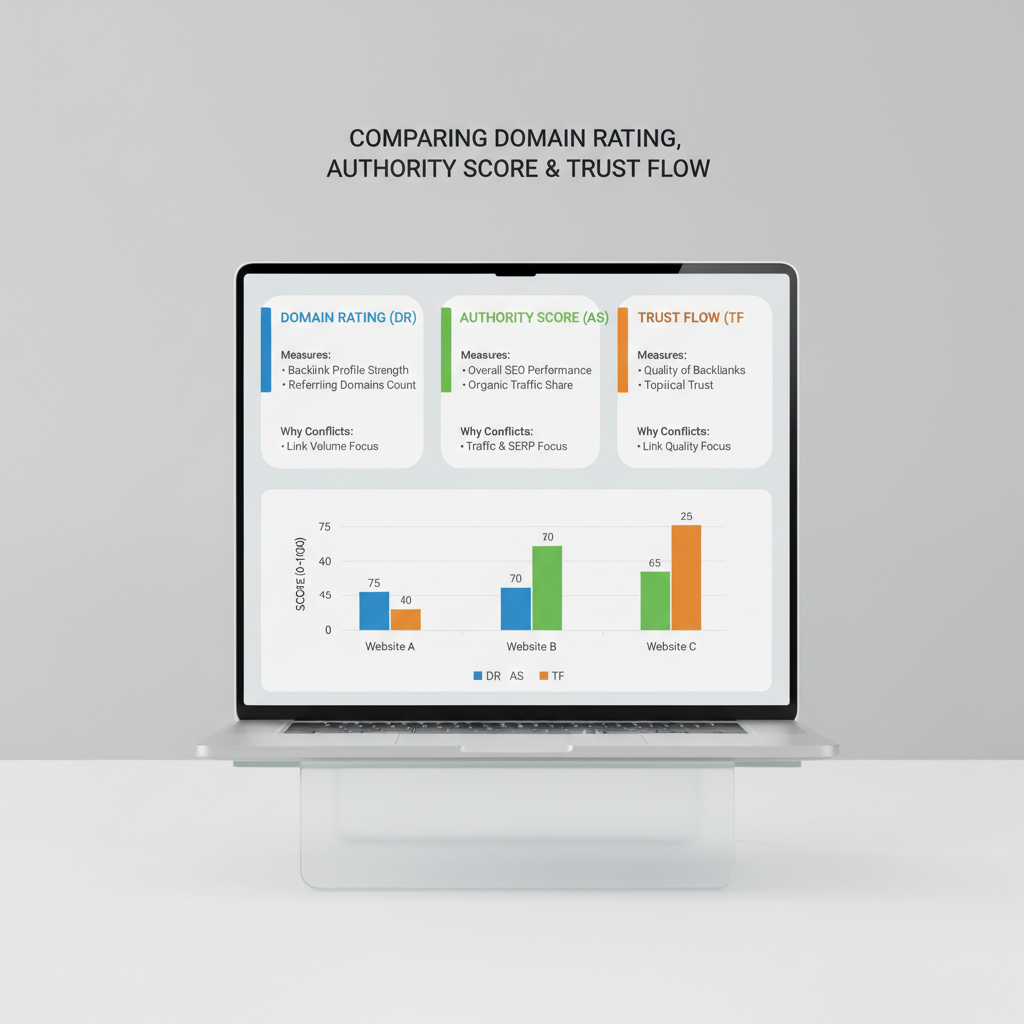
A single website can simultaneously display a high DR, an average Semrush Authority Score, and a low Majestic Trust Flow. Each tool runs distinct calculation models, and none reflects Google’s internal scoring.
What each metric measures
Domain Rating (DR) evaluates the quality and volume of unique referring domains and backlink equity. It measures raw backlink network strength regardless of keyword rankings.
Semrush Authority Score integrates estimated organic search traffic and ranking keywords directly into its backlink calculation. A site with strong links but zero search traffic receives a lower Semrush Authority Score than its DR might suggest.
Majestic Trust Flow measures link proximity to a curated set of trusted seed websites. Sites with backlinks originating close to trusted educational, governmental, or major editorial sources earn higher Trust Flow scores.
Why the scores conflict
Search platforms crawl the web independently and refresh indexes on separate schedules. A site might show 0 backlinks in one index while another tool displays newly crawled links.
Use third-party metrics as comparative signals rather than definitive ranking measures:
|
Metric |
Primary Data Source |
Best Use Case |
|---|---|---|
|
Ahrefs DR |
Inbound backlink profile and referring domains |
Evaluating link-building velocity and backlink strength |
|
Semrush AS |
Backlinks, organic traffic, and keyword rankings |
Assessing broad domain visibility and search performance |
|
Majestic TF |
Proximity to trusted web seed sites |
Auditing backlink trust and link spam risk |
|
Google Search Console |
Real impressions, clicks, and queries in Google |
Tracking actual search demand and performance |
Google Search Console provides definitive user performance data. If a domain shows strong third-party authority scores but registers low search impressions, its theoretical backlink profile is not generating organic search demand.
Review Search Console data to verify that your highest-DR links point to relevant pages driving actual impressions. You can also refine your on-page elements while reviewing link data by running titles through this free SEO title checker before publishing.
Summary of Domain Rating utility in modern SEO campaigns
Domain Rating (DR) serves as an effective relative metric for estimating backlink strength. It helps teams benchmark competitors and track link velocity, but search engines do not use it to calculate search results.
Google relies on internal systems, including PageRank, content helpfulness, and topical relevance. Use DR as an initial screening tool rather than a comprehensive SEO KPI.
Use DR as a screening signal
Filter prospective link targets using a balanced evaluation process:
-
Organic traffic: Verify that the domain ranks for terms related to your industry using organic research tools.
-
Topical relevance: Ensure the site addresses your target market and produces contextually related articles.
-
Referring domain distribution: Review the target’s link profile for natural growth across unique domains.
-
Editorial standards: Check for proper author attributions, original analysis, and natural outbound citations.
-
Page experience: Avoid domains with excessive ad clutter, invasive pop-ups, or uncurated syndicated content.
Build a responsible workflow
Document target DR, estimated organic traffic, topical relevance, and page-level outbound links within your outreach workflow. Focus on pages where your link serves as a natural reference for readers.
Avoid chasing DR increases as your primary SEO objective. Pair third-party metrics with organic traffic audits, relevance checks, and Search Console performance data to build a sustainable search profile.
Frequently asked questions
What is a good DR Score?
A good DR score depends on your industry and competitor benchmarks. For small sites and niche blogs, scores between 10 and 30 are standard. Established business sites typically sit between 30 and 50, while top industry publications reach 50 to 60+. Focus on outranking direct search competitors rather than chasing a global 100 rating.
If a website has a high DR, does it mean it’s a good website to get links from?
Not always. A domain can retain a high DR through legacy backlinks while generating zero organic search traffic or publishing low-quality content. Always evaluate organic traffic trends, topical relevance, and page-level outbound link counts before building a link.
Why is my DR much higher or lower than my UR?
Domain Rating (DR) evaluates the aggregate backlink profile of your entire domain, while URL Rating (UR) measures the backlink strength of a specific, individual web page. A website can have a high overall DR while a newly published blog post has a low UR.
I didn’t lose any backlinks. why did my DR drop?
Ahrefs calculates DR on a relative scale across its entire index. If competing websites acquire quality backlinks faster than your site, your domain shifts downward during scheduled recalculations, even if your total backlink count remains unchanged.
How come my DR is lower than that of my competitor even if I have more backlinks?
Ahrefs weights unique referring domains and their relative authority over gross backlink volume. A competitor with 50 links from high-authority, relevant domains will achieve a higher DR than a site with 500 links originating from low-tier or diluted sources.
Is Domain Rating a direct Google ranking factor?
No. Google does not use Ahrefs Domain Rating within its search algorithms. Search engines evaluate backlinks through proprietary technologies like PageRank, contextual relevance, and search intent signals. DR remains a third-party analytical metric.
Put this on autopilot
Seobase runs the whole loop for you: it finds the keywords worth ranking for, writes and publishes the articles, and reports back from Search Console on what actually moved.
See how Seobase worksIn this guide
- Understanding DR in SEO and Authority metrics
- How Ahrefs calculates Domain Rating on a logarithmic scale
- Why your DR can drop even when you lose zero backlinks
- Evaluating link value: why high-dr sites are not always good targets
- Comparing DR with Semrush Authority Score and majestic trust Flow
- Summary of Domain Rating utility in modern SEO campaigns
- Frequently asked questions